The vagus nerve has become a wellness buzzword — but it's also a real, well-mapped cranial nerve with a genuine role in how your body recovers from stress. Here's what it actually is, how it works, and what's genuinely supported by research, separated from the marketing layered on top of it.
What Is the Vagus Nerve? The Anatomy of the "Wandering Nerve"
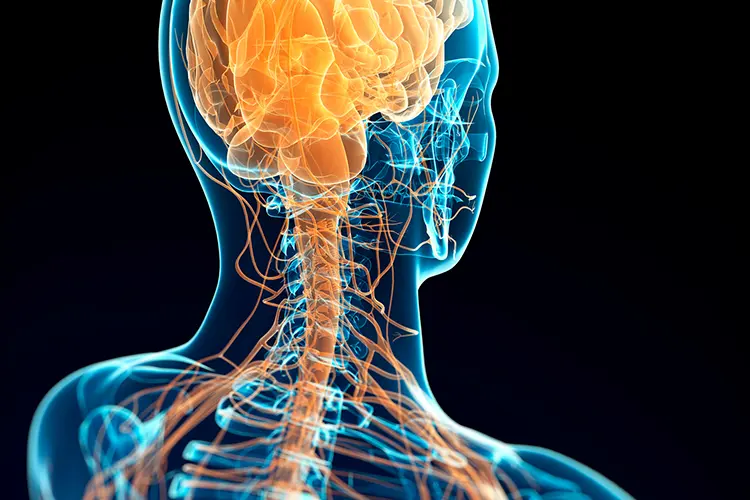
The vagus nerve is the tenth of the twelve cranial nerves and the longest by a considerable distance. Where most cranial nerves confine their influence to the head and neck, the vagus travels from the brainstem all the way down through the neck, into the chest, and through the abdomen — branching along the way to reach the pharynx, larynx, heart, lungs, stomach, liver, kidneys, and most of the large and small intestine.
This unusually wide reach is where the name comes from: vagus is Latin for wandering, which is why you'll sometimes see it referred to as the "wandering nerve" in both clinical and consumer health writing. It's a fitting description — no other cranial nerve covers as much anatomical territory.
In terms of structure, roughly 80% of the vagus nerve's fibres are afferent — sensory — carrying information from the organs upward to the brain, rather than the reverse. The remaining 20% are efferent fibres carrying motor signals down from the brainstem to the organs. This predominantly bottom-up architecture is part of why researchers increasingly describe the gut-brain connection as a genuinely two-directional system — the body is informing the brain as much as the brain is directing the body.

The Vagus Nerve and the Parasympathetic System: Your Body's Stress Brake
The vagus nerve is the primary outflow pathway of the parasympathetic nervous system — the branch of the autonomic nervous system responsible for what's commonly called the "rest and digest" state, as opposed to the sympathetic system's "fight or flight" response. To understand what stimulating the vagus nerve is meant to do, it helps to understand this broader context. For a fuller explanation of how these two systems interact, our beginner's guide to stress and the nervous system covers the basics.
When the vagus nerve fires, its efferent fibres release acetylcholine — the primary neurotransmitter of the parasympathetic system — at the target organ. At the heart, acetylcholine binds to receptors that slow the heart rate. In the digestive tract, it stimulates peristalsis and digestive enzyme secretion. In the immune system, the same mechanism forms the basis of what researchers call the cholinergic anti-inflammatory pathway, through which vagal activity can actively suppress the production of pro-inflammatory cytokines.
The result, when the vagus nerve is sufficiently active, is a shift toward recovery: lower heart rate, deeper breathing, better digestion, and a dampened inflammatory response. When the sympathetic system dominates — as it does under chronic stress — vagal tone is actively suppressed, and this recovery state becomes harder to access even when the acute threat has passed.
This is the genuine biological basis for why the vagus nerve has attracted so much attention. If chronic stress keeps the sympathetic system chronically elevated, anything that reliably increases parasympathetic activity is a plausible intervention for the physical effects of that stress. The important caveat is that the quality of evidence for different methods of achieving this varies considerably — which is what this site exists to clarify.
Vagal Tone and HRV: What Do These Measurements Actually Tell You?
You can't directly measure vagal activity with a consumer device. What devices do instead is measure heart rate variability (HRV) — the variation in time between heartbeats — as a proxy.
The logic is as follows: the vagus nerve is a key modulator of heart rate, exerting a continuous braking influence on the sinoatrial node (the heart's natural pacemaker). Higher HRV indicates that the heart is responding flexibly to internal and external demands, which is associated with stronger parasympathetic function and, by extension, higher vagal tone. Lower HRV is associated with a more rigid, less adaptable cardiovascular system, and has been linked to poorer health outcomes across a range of conditions.
This is a genuinely useful and reasonably well-evidenced relationship. It is also not a precise measurement. HRV is influenced by many factors beyond the vagus nerve alone — including fitness level, sleep quality, time of day, recent exercise, hydration, alcohol consumption, and even breathing rate at the moment of measurement. A single low HRV reading is not a reliable signal of poor vagal tone, and wearable devices vary considerably in how accurately they calculate HRV from optical sensors at the wrist.
The more useful application is tracking HRV over time as one signal among several, rather than treating any single reading as a diagnostic fact.
The Gut-Brain Axis: What Signals Does the Vagus Nerve Actually Carry?
A significant portion of current research interest in the vagus nerve concerns its role in the gut-brain axis — the bidirectional communication network between the digestive system and the central nervous system. The vagus nerve is one of the primary physical pathways of this network, alongside the immune system, the enteric nervous system, and microbial metabolite signalling.
This is a genuinely active and rapidly developing area of research. The signals travelling up the vagus from the gut include information about gut distension, pH, nutrient content, inflammatory markers, and even signals from the gut microbiome — which helps explain why gut health has become a legitimate focus of mental and cognitive health research, not just a marketing category.
It is also, however, one of the areas where consumer marketing most reliably outpaces the established evidence. Many specific claims — fixing mood, eliminating anxiety, improving cognition, or healing gut conditions "via the vagus nerve" — go well beyond what controlled human studies currently demonstrate. The existence of a plausible pathway is not the same as demonstrated efficacy for a specific intervention. We apply that distinction consistently across everything reviewed on this site.
Vagus Nerve Stimulation: Devices vs. Free Methods — Where Does the Evidence Sit?
Given that "Neuro-Tech Devices" is one of this site's three content categories, it's worth being direct about where device-based vagal stimulation sits relative to free physiological methods.
Free methods — including slow, extended-exhale breathing, cold water facial exposure (which triggers the dive reflex), and sustained humming or vocalisation — all have at least some supporting research for their effect on vagal activity, primarily through short-term changes in HRV and heart rate. The evidence is modest, often small-sample, and rarely addresses long-term outcomes, but the interventions are low-cost and low-risk. We cover these in more detail in our guide to free vagus nerve stimulation methods.
Transcutaneous vagus nerve stimulation (taVNS) devices — including ear-clip devices like Nurosym — work differently. Rather than using physiological manoeuvres to indirectly influence vagal tone, they deliver mild electrical stimulation to the auricular branch of the vagus nerve, which is accessible at the outer ear. This is a more targeted mechanism with a growing but still-developing evidence base. We look at that evidence directly — including what specific clinical trials did and didn't measure — in our Nurosym review and our broader guide to the evidence for VNS and anxiety.
Neither category is a complete answer on its own. Free methods have minimal cost and risk but less consistency and standardisation. Devices offer more repeatable stimulation but at significant cost, and the evidence for consumer-grade taVNS specifically is still catching up with the marketing. The most defensible position, based on current evidence, is that both represent plausible tools for supporting parasympathetic function — with the caveat that neither addresses the underlying causes of chronic stress.
Frequently Asked Questions
Yes. Vagus is Latin for wandering, and the term refers to the same cranial nerve — it reflects its unusually long, branching path from the brainstem down to the abdomen, unlike most cranial nerves which stay in the head and neck.
Yes — methods like slow diaphragmatic breathing, cold water exposure, and humming have research behind them as ways to influence vagal activity, though the evidence varies in strength by method. We cover each of these in our guide to free vagus nerve stimulation methods.
Not directly. Vagal tone is one marker connected to stress recovery, but it doesn't capture the whole picture of someone's stress levels. HRV is the most commonly used proxy, though it's influenced by many factors beyond the vagus nerve alone — including fitness, sleep, and hydration.
It depends on the method and outcome. Implanted VNS for epilepsy and treatment-resistant depression has a multi-decade evidence base. Consumer taVNS devices for everyday stress and anxiety have a smaller, more preliminary evidence base — we break this down by method in our guide to the evidence for VNS and anxiety.
Acetylcholine is the primary neurotransmitter used by vagal efferent fibres to communicate with target organs. When the vagus nerve fires, acetylcholine is released — slowing heart rate, supporting digestion, and actively braking the sympathetic stress response. This is why vagal stimulation is sometimes described as activating the body's parasympathetic "brake."
LessStress.ie
LessStress.ie covers neuro-tech devices, sleep science and brain health for an Irish audience, with every product claim checked against the real peer-reviewed evidence before it gets a recommendation.
Related Articles


Sources & Further Reading
- Berthoud, H.R. & Neuhuber, W.L. (2000). Functional and chemical anatomy of the afferent vagal system. Autonomic Neuroscience, 85, 1–17. View on PubMed ↗
- Task Force of the European Society of Cardiology and the North American Society of Pacing and Electrophysiology. (1996). Heart rate variability: standards of measurement, physiological interpretation and clinical use. Circulation, 93(5), 1043–1065. View on PubMed ↗
- Cryan, J.F., O'Riordan, K.J., Cowan, C.S.M., et al. (2019). The Microbiota-Gut-Brain Axis. Physiological Reviews, 99(4), 1877–2013. View on PubMed ↗