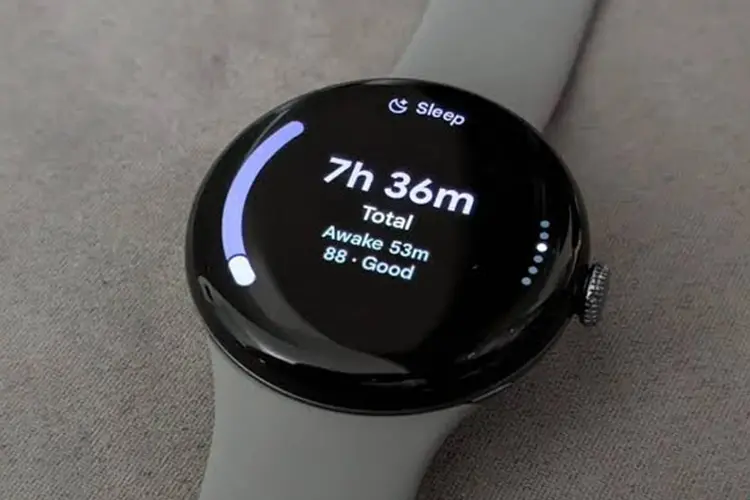
Sleep scores and stage breakdowns are now standard on most smartwatches. The honest answer on accuracy is: reasonably good for detecting whether you slept, considerably less reliable for the specific stage percentages that feature prominently in the app dashboard — and the gap matters if you're using your score to make health decisions.
Polysomnography: What the Clinical Gold Standard Actually Measures
Polysomnography (PSG) is the clinical standard for sleep assessment, used in sleep laboratories to classify sleep into stages — wake, light sleep (N1 and N2), deep sleep (N3/slow-wave), and REM — with a level of physiological detail that consumer wearables can't match.
A full PSG uses EEG electrodes on the scalp to measure electrical brain activity directly, alongside eye movement sensors (EOG) for REM detection, chin and limb muscle sensors (EMG), and respiratory monitoring. The combination of these signals allows trained technicians (and validated automated algorithms) to classify each 30-second epoch of the night by sleep stage with a high degree of accuracy.
That accuracy isn't perfect even in a lab setting — between two trained PSG scorers, agreement tends to fall around 80–85% — but it represents the current best available measure of what's actually happening during sleep.
How Consumer Wearables Actually Track Sleep — and Why That Limits Them
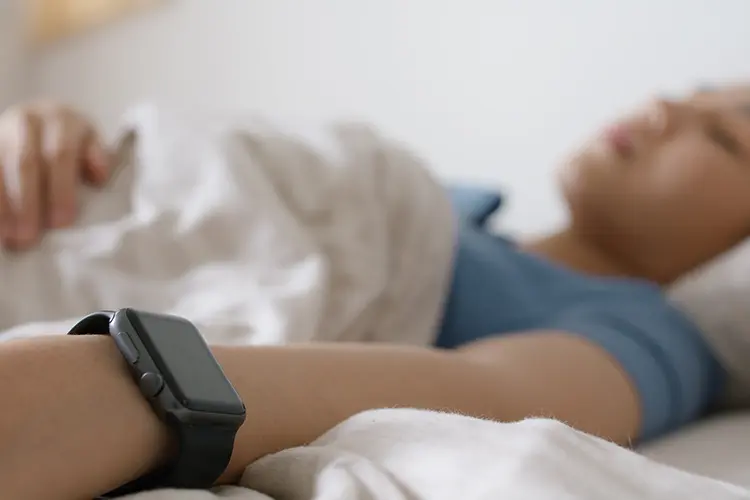
Most wrist-worn consumer sleep trackers — including Apple Watch, Fitbit models, Garmin, Oura Ring, and Whoop — rely primarily on two sensor types: an accelerometer (detecting wrist movement and stillness) and a photoplethysmography (PPG) sensor (the optical heart rate monitor that measures pulse). More advanced models also incorporate skin temperature and SpO2 sensors.
From these inputs, the device's proprietary algorithm attempts to infer sleep stages — essentially reverse-engineering the brain state from peripheral physiological signals that correlate with, but don't directly measure, neural activity. This is a fundamentally less precise approach than EEG-based staging, and the accuracy difference is reflected in the research.
What the Validation Studies Actually Found: Apple Watch, Fitbit, and Others vs PSG
A 2024 validation study conducted by researchers at Brigham and Women's Hospital and Harvard Medical School compared the Oura Ring Gen3, Fitbit Sense 2, and Apple Watch Series 8 against overnight PSG in 35 participants. Key findings for sleep versus wake detection: all three devices showed high sensitivity (≥95%), meaning they were good at identifying when participants were asleep overall.
For specific sleep stage classification, accuracy dropped considerably and varied by device. The Apple Watch underestimated deep sleep by an average of 43 minutes and overestimated light sleep by 45 minutes. The Fitbit underestimated deep sleep by 15 minutes and overestimated light sleep by 18 minutes. The Oura Ring performed best of the three, showing no statistically significant underestimation or overestimation of any stage — though all three devices showed moderate rather than strong agreement with PSG at the epoch-by-epoch level.
A separate multi-device validation study published in 2025, testing six devices including Fitbit Charge 5, Fitbit Sense, and Apple Watch Series 8 against PSG in 62 adults, found that Cohen's kappa coefficients (a measure of agreement beyond chance) ranged from 0.21 to 0.53 across devices — described by the researchers as fair to moderate agreement. All devices detected over 90% of sleep epochs, but showed significantly lower specificity for distinguishing wake periods.
What This Means for How You Should Use Your Sleep Data
The pattern across validation studies is consistent: consumer wearables are reasonably reliable for total sleep time and basic sleep/wake detection, and considerably less reliable for specific stage percentages — especially deep sleep, which Apple Watch appears to particularly underestimate.
This has practical implications. Using your sleep score to notice broad trends over time — whether your sleep duration correlates with next-day focus, whether later bedtimes reduce your deep sleep estimate, whether travel or alcohol produce lower scores — is a reasonable and legitimate application of the data. Treating a specific stage percentage ("I got 15% deep sleep last night") as a clinically precise measurement, or making significant health decisions based on single-night readings, gives the data more credit than the research supports.
If you are using sleep data to try to understand and address broader issues like poor concentration or brain fog, it's worth contextualising that data alongside the other factors covered in our guide to brain fog and the real causes of poor sleep.
Frequently Asked Questions
Total sleep time is reasonably accurate. Sleep stage classification is considerably less reliable — a 2024 Harvard study found Apple Watch overestimated light sleep by 45 minutes and underestimated deep sleep by 43 minutes on average compared to PSG.
Sleep labs use scalp EEG to directly measure brain electrical activity — the biological basis of sleep staging. Smartwatches infer stages indirectly from wrist movement and optical heart rate, which is a fundamentally less precise proxy for neural state.
Reasonable for broad trends over time. Less reliable for precise nightly stage breakdowns. Treat your sleep score as a useful signal, not a clinical measurement — especially for specific stage percentages.
If you suspect a condition like sleep apnoea, restless legs, or another disorder, a clinical evaluation is the appropriate route. A smartwatch sleep score is not a diagnostic tool and should not substitute for medical assessment.
LessStress.ie
LessStress.ie covers neuro-tech devices, sleep science and brain health for an Irish audience, with every product claim checked against the real peer-reviewed evidence before it gets a recommendation.
Related Articles
Sources & Further Reading
- Robbins, R., Weaver, M.D., Sullivan, J.P., et al. (2024). Accuracy of Three Commercial Wearable Devices for Sleep Tracking in Healthy Adults. Sensors, 24(20), 6532. View on PMC ↗
- Schyvens, A-M., Peters, B., Van Oost, N.C., et al. (2025). A performance validation of six commercial wrist-worn wearable sleep-tracking devices for sleep stage scoring compared to polysomnography. SLEEP Advances, 6(2). View on PMC ↗